
A Practical Guide for Serious Job Seekers
In 2026, your resume is no longer just a document — it’s your personal marketing tool.
Companies now use AI-powered screening systems, skill-based hiring models, and LinkedIn cross-verification before shortlisting candidates. If your resume isn’t strategically written, it may never reach a recruiter.
So how do you create a resume that actually gets interview calls?
Let’s break it down step by step.
Step 1: Understand How Hiring Works in 2026
Before writing your resume, understand what happens after you click “Apply.”
1️⃣ Your resume enters an ATS (Applicant Tracking System)
2️⃣ The system scans for keywords
3️⃣ Only matching resumes move forward
4️⃣ Recruiters scan shortlisted profiles for 6–8 seconds
5️⃣ Decision: Interview call or rejection
Your resume must pass both machines and humans.
Step 2: Make Your Resume ATS-Friendly
Many qualified candidates get rejected because their resume is not readable by ATS software.
To optimize your resume:
✔ Use standard headings (Professional Summary, Skills, Experience, Education)
✔ Avoid tables, graphics, and fancy templates
✔ Use clean fonts like Calibri or Arial
✔ Keep it 1–2 pages
✔ Match keywords with the job description
One common mistake we often see at Skilledom while reviewing resumes is over-designed templates that look good visually but perform poorly in ATS systems.
Simple. Clean. Strategic. That wins in 2026.
Step 3: Focus on Achievements, Not Responsibilities
Recruiters are not impressed by job duties. They are impressed by results.
Instead of:
❌ Responsible for handling sales
Write:
✔ Increased monthly revenue by 30% through structured client follow-ups
Instead of:
❌ Managed maintenance operations
Write:
✔ Reduced machine downtime by 22% by implementing preventive maintenance planning
Numbers create credibility. Measurable impact creates interest.
Across industries — from IT and Manufacturing to Sales and Healthcare — achievement-based resumes consistently generate higher response rates.
Step 4: Write a Powerful Professional Summary
Your summary is your first impression.
It should answer three questions:
- Who are you?
- What is your expertise?
- What value do you bring?
Example:
Results-driven Mechanical Engineer with 4+ years of experience in preventive maintenance and production optimization. Reduced downtime by 18% and improved operational efficiency by 20%.
Avoid generic lines like:
“Seeking a challenging opportunity in a growth-oriented organization.”
Recruiters skip vague statements.
Step 5: Align Your Resume with Your LinkedIn Profile
In 2026, recruiters check LinkedIn before scheduling interviews.
Your LinkedIn should:
✔ Match your resume title
✔ Highlight your key skills
✔ Showcase measurable achievements
✔ Have a strong professional headline
If your resume says one thing and LinkedIn says another, it reduces credibility.
Professionally aligned profiles significantly increase recruiter trust and visibility.
Step 6: Customize for Every Job Application
Mass applying with the same resume doesn’t work anymore.
Instead:
- Read the job description carefully
- Identify required skills
- Adjust your keywords
- Tailor your summary
Even small adjustments can increase your ATS match score dramatically.
Step 7: Showcase Skills & Certifications
In 2026, skills matter more than degrees.
Add:
✔ Technical certifications
✔ Industry training
✔ Projects
✔ Performance awards
This positions you as an active, growth-focused professional.
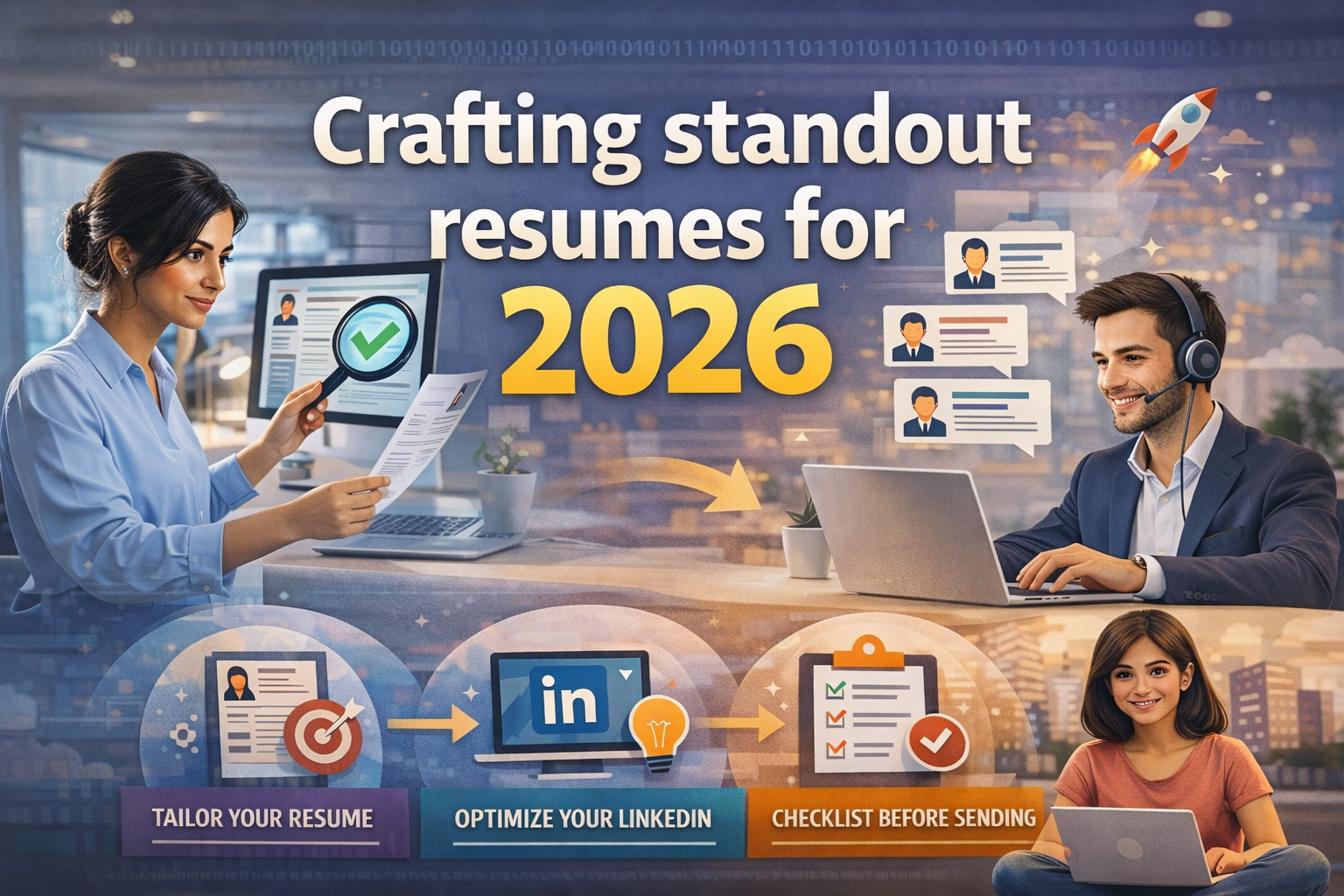
Resume Checklist Before Sending
Before applying, ask yourself:
☑ Is my resume tailored for this role?
☑ Have I included measurable achievements?
☑ Is it ATS-friendly?
☑ Is LinkedIn aligned with my resume?
☑ Is formatting clean and professional?
If you’re unsure about any of these, your resume may need refinement.
Why Strategic Resume Positioning Matters
A resume is not just about listing experience — it’s about positioning your value.
At Skilledom, after reviewing thousands of profiles across industries, one pattern is clear:
Candidates who present measurable achievements, keyword alignment, and clear positioning receive significantly more interview calls than those using generic templates.
That’s why strategic resume writing — not just formatting — makes the difference.
Final Thoughts
In 2026, the job market is competitive — but not impossible.
The professionals who get interview calls are not always the most experienced.
They are the ones who present their experience clearly, strategically, and confidently.
Your resume should clearly answer one question:
👉 “Why should we hire you?”
If it does that effectively, interview calls will follow.
Ready to Upgrade Your Resume Strategy?
If you want your resume professionally optimized for:
✔ ATS compliance
✔ Achievement-based writing
✔ Industry-specific positioning
✔ LinkedIn profile alignment
You can explore Skilledom Profile & Resume Services at:
🌐 www.skilledom.com/register-candidate/
Position yourself better. Get noticed faster. Receive more interview calls.