

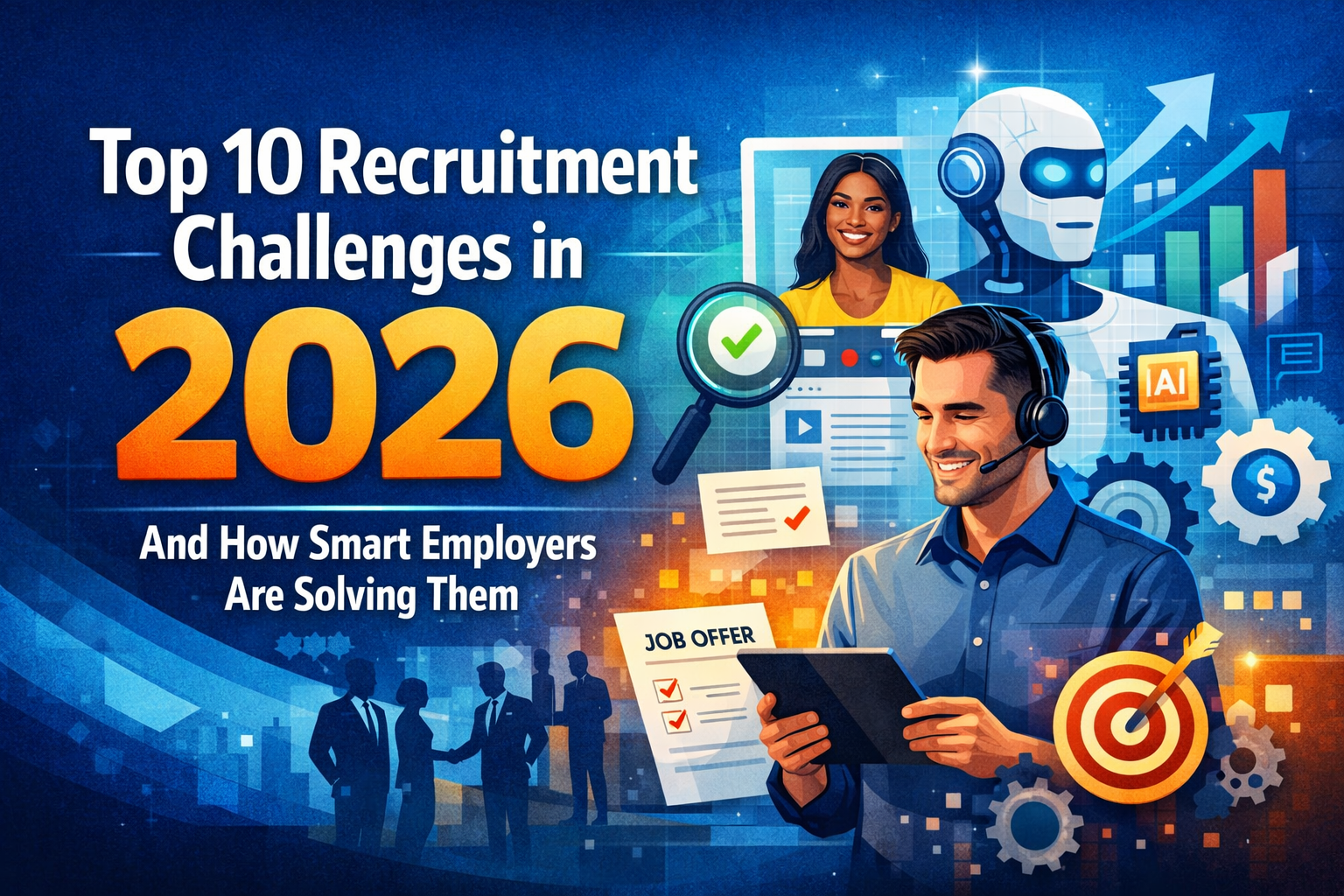
The recruitment landscape in 2026 looks very different from even a few years ago. Rapid AI adoption, rising labour costs in some regions, shifting candidate expectations, and tighter regulatory scrutiny have combined to make attracting and keeping talent both more strategic and more complicated. Below I break down the top 10 recruitment challenges HR and hiring teams are facing right now — and give clear, practical fixes you can implement this quarter.
Quick snapshot: AI is accelerating change in the labour market and shifting which roles are in demand; employers also face cost pressures and continued skills shortages in many sectors.
1. Balancing AI automation with human judgment
The problem: AI tools (resume parsers, automated interviews, chatbots, skill-assessment engines) can speed hiring but also produce false negatives, amplify bias if misused, or alienate candidates who feel dehumanized. Many candidates and regulators are increasingly skeptical of “black-box” hiring decisions.
How to solve it
- Use AI to augment — automate admin tasks (scheduling, initial screening) but keep humans in the loop for final decisions and subjective evaluations.
- Require vendor transparency: only use tools that provide explainability on scores and allow manual overrides.
- Run bias audits regularly (A/B test outcomes with and without AI filters).
- Communicate to candidates when AI is used and why — transparency increases trust.
Quick metric to track: % of hires where final offer differed from AI recommendation.
2. Skills mismatch and shortage of job-ready talent
The problem: Employers struggle to find candidates with up-to-date technical or hybrid skills — and degree requirements are becoming less predictive of job performance. The rise of skills-based hiring is real, but adoption is uneven.
How to solve it
- Shift to skills-based job descriptions (score required skills vs. “nice-to-have”).
- Invest in commissioned microtraining or partner with bootcamps to build pipelines.
- Build internal “grow-your-own” programs and apprenticeship models.
- Use validated skills assessments early to identify potential over pedigree.
Quick metric to track: Time-to-proficiency for new hires (instead of only time-to-hire).
3. Candidate experience fatigue (slow, impersonal processes)
The problem: Long hiring cycles, poor communication, and one-size-fits-all status emails push candidates away — particularly Gen Z and passive talent who expect fast, personalized digital experiences.
How to solve it
- Map the candidate journey and remove unnecessary steps (one-click apply, faster hiring committee reviews).
- Automate personalized touchpoints (e.g., tailored status updates, short video responses from hiring managers).
- Set SLAs for response times (e.g., initial reply within 48 hours).
- Ask candidates for feedback and publish improvements (closing the loop builds brand).
Quick metric to track: Candidate Net Promoter Score (cNPS) and drop-off rates at each stage.
4. Employer branding vs. truth — expectations vs. reality
The problem: Candidates research employers intensely. If your public brand promises flexibility, learning, or inclusive culture — but interviews and onboarding don’t reflect that — offers are declined or early attrition spikes.
How to solve it
- Align employer messaging with employee realities (transparent benefits, hybrid policies, growth paths).
- Encourage employee-generated content — short day-in-the-life videos and testimonials.
- Train managers who interview to authentically represent team culture.
- Track offer-acceptance reasons and act on recurring themes.
Quick metric to track: Offer acceptance rate and reasons for decline.
5. Retention pressure — hiring is one thing; keeping talent is another
The problem: High turnover or “flight risk” among high performers increases hiring volume and cost. Once onboard, employees expect rapid growth, recognition, and clear career paths.
How to solve it
- Pair hiring with retention playbooks: 30/60/90 onboarding plans, mentorship, and role roadmaps.
- Conduct stay interviews (not just exit interviews) to understand retention drivers.
- Use people analytics to spot early signs of disengagement (decline in productivity, fewer internal applications).
Quick metric to track: Retention rate of hires at 12 months; % internal promotions.
6. Compliance, privacy, and ethical hiring rules
The problem: New regulations (data protection, AI decision-making, pay transparency, sector-specific rules) mean recruiters must be careful with candidate data, screening tests, and automated decision tools. Non-compliance risks fines and reputation damage.
How to solve it
- Centralize candidate data policies: consent management, data retention limits, and clear access controls.
- Maintain an approved-vendor list — only tools that meet your legal/privacy checklist.
- Assign a compliance owner for hiring and run quarterly policy reviews.
- Keep records of decisions where automation played a role to demonstrate due diligence.
Quick metric to track: Compliance audit pass rate and number of data incidents.
7. Diversity, equity, and inclusion (DEI) in a measurable way
The problem: Companies want diverse teams but struggle to build fair, scalable hiring processes and defensible metrics. Some AI tools can either help or hurt DEI depending on data and implementation.
How to solve it
- Adopt skills-based, structured interviews to reduce bias (same questions, scoring rubric).
- Use anonymized skills assessments for early-stage screening when possible.
- Set measurable DEI targets by role and level; report progress transparently.
- Provide bias-awareness training for interviewers and hire diverse interviewer panels.
Quick metric to track: Conversion rates for underrepresented groups at each funnel stage.
8. Rising hiring costs and ROI pressure
The problem: Labour costs and the total cost-per-hire are rising in many markets; companies are under pressure to show hiring ROI. Automation can cut cost but may erode candidate quality if misapplied.
How to solve it
- Move from cost-per-hire to hire-quality KPIs (first-year performance, retention).
- Build direct sourcing channels (talent communities, employee referral incentives).
- Centralize analytics: which channels produce best long-term hires? Double down.
- Negotiate vendor outcomes (e.g., pay-for-performance for agencies).
Quick metric to track: Cost-per-quality-hire (blend cost and performance metrics).
9. Hybrid / remote complexity and geographic hiring laws
The problem: Hiring across regions brings tax, payroll, benefits, and employment-law complexity — especially as remote work expands. Companies must decide where and how to hire globally.
How to solve it
- Define clear remote-work policies: which roles are remote-eligible, local allowances, and core hours.
- Use Employer-of-Record (EOR) partners for payroll and compliance in new countries.
- Localize offers (benefits, compensation benchmarking, statutory requirements).
- Train managers on leading distributed teams and measuring performance by outcomes.
Quick metric to track: % of roles with clear remote eligibility + compliance incidents by country.
10. Speed vs. quality: hiring fast without breaking the bar
The problem: Pressure to close roles quickly can lead to shortcuts, mismatched hires, and re-opened vacancies. Speed is important — but not at the expense of quality.
How to solve it
- Implement structured hiring sprints: defined timeline with gated decision points and owner accountability.
- Use short, practical work-samples or paid trial projects to validate capability quickly.
- Maintain a “ready-now” candidate pool and keep top passives warm.
- Empower recruiters with decision rights for common roles, reducing bottlenecks.
Quick metric to track: Requisition re-open rate within 6 months.
A quick hiring-play checklist you can use this week
- Audit your use of AI: vendor list + transparency confirmation.
- Convert 2 high-priority job descriptions to skills-based templates.
- Set a 48-hour SLA for candidate first response and measure compliance.
- Launch 1 microtraining/apprenticeship pilot for a hard-to-fill role.
- Run a one-page hiring compliance checklist for international hires.
Final thoughts
2026’s hiring challenges are less about a single disruptive trend and more about complexity: AI, cost pressures, changing candidate expectations, and regulation are all happening at once. The organizations that win will be those that combine technology with human-centered design — i.e., use automation to remove friction while investing in candidate experience, skills development, and measurement.
At Skilledom, we help employers simplify hiring, reduce risk, and access job-ready talent faster — whether for permanent roles, contract workforce, or specialized technical hiring.
Because recruitment isn’t just about filling roles.
It’s about building workforce strength.